
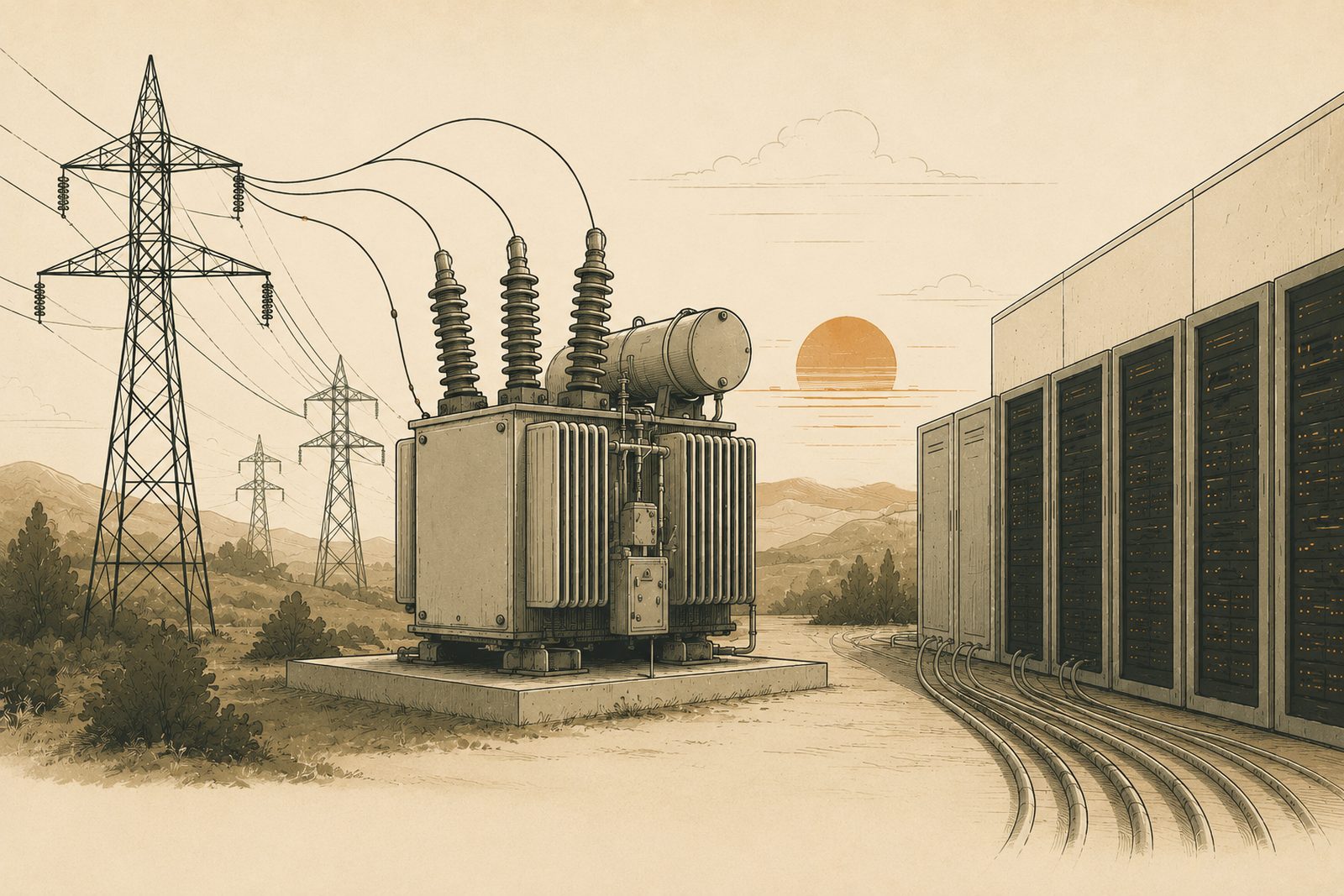
The dominant story of artificial intelligence is a story of silicon: faster chips, more memory, more compute. But anyone who plans infrastructure knows that the bottleneck of 2026 is not in a factory in Taiwan, it is in a substation. Before a single GPU does any useful work, someone has to connect megawatts of load to the power grid, and that is where the system jams. The component that decides it is neither exotic nor new: it is the power transformer, a piece of steel and copper that AI, however much money it has, cannot buy in time.
In Europe the problem has a flavour of its own. Where the United States competes for factory slots and flees the grid by building its own gas plants, Europe runs into longer connection queues, an older grid and a more coordinated, publicly led response. It is worth understanding the mechanics before weighing in on the solutions.
01 The limit isn't silicon, it's steel
An AI data centre is a dense electrical load: tens or hundreds of megawatts concentrated in a single site. To feed it you have to step the high voltage of the transmission grid down to usable voltage, and only a power transformer does that. The heart of that transformer is a core of grain-oriented electrical steel (GOES), a material whose microstructure is aligned to minimise magnetic losses. No GOES, no core; no core, no transformer; no transformer, no connection. Europe acknowledges this bluntly in its own documentation: the EU is "increasingly dependent on a small number of suppliers" of both transformers and the copper in cables. The timelines confirm it: manufacturing a transformer has gone from about 50 weeks in 2021 to close to two years in 2025.
02 Why capital can't manufacture a transformer
Here lies the sector's most expensive misunderstanding. Compute scales with software and money; the transformer does not. It is a long-cycle industrial product made by specialised labour: winding, vacuum-drying the insulation, high-voltage dielectric testing. It cannot be printed or parallelised. You can speed it up by building new plants and training winders, but that takes years. Europe is putting up the capital, TenneT alone is committing €200 billion through 2034 to expand the German and Dutch grids, and even so the schedule is set by the physical supply chain, not the balance sheet. Announcing investment and having equipment in the substation are two things separated by several years.
03 The queue that won't move: seven to ten years
If manufacturing is slow, connection is worse. In Europe's big data-centre hubs, the so-called FLAP-D markets (Frankfurt, London, Amsterdam, Paris and Dublin), the waits to obtain a grid connection average seven to ten years. And the queue is not only demand: according to the tally circulated in early June, more than €100 billion in renewable projects, some 830 GW of wind, solar and batteries, are stuck waiting for hook-up across eight European countries. The mismatch is structural: planning, permitting and building grid takes five to fifteen years, while a data centre goes up in one to three. Compute supply runs; the grid walks.
04 Two philosophies facing the same wall
This is where Europe and the United States part ways. The American response is one of markets and escape: faced with interconnection queues of four to seven years, the hyperscalers bypass the grid and build their own generation, mostly gas turbines (GE Vernova is targeting around 20 GW of turbines a year in 2026). The European response is one of public coordination. The EU Grids Package puts grid investment needs at around €584 billion under its 2022 modelling, with a horizon figure reaching €1.2 trillion for 2024-2040, and, above all, sets an industrial target: to cover 40% of equipment needs domestically by 2030. It is the difference between dodging the problem and redesigning the factory that causes it.
05 When load becomes a political decision
Europe has done something barely seen in the United States: treating a data centre's connection as a policy lever. The Netherlands and Ireland imposed de facto moratoria. Ireland lifted its in December 2025, but replaced it with measurable conditions: a new centre must provide its own or nearby generation equivalent to 100% of its demand and match 80% of its consumption with renewables. Denmark went further in March 2026: its operator, Energinet, paused new connection agreements amid an "explosion" of requests, with some 60 GW in the queue, 14 GW of which are data centres. In Dublin, data centres already account for close to 80% of local electricity consumption. The load of compute has stopped being a technical figure and become a variable that regulators switch on and off.
06 The flexibility that changes the equation
The figure that most deflates the panic comes from the demand side. A study by Duke University calculates that if data centres agreed to cut their load just 0.25%-0.5% of the time, around 44 hours a year, with events averaging about two hours, the existing grid could absorb between 76 and 100 GW of new load without expanding capacity. Translated: much of the bottleneck is not physical, it is rigidity. Treating a data centre as a firm, 24-hour load is a design choice, not a law of nature. Europe is starting to see it this way, from the "data centre as a threat to the grid" to the "data centre as a grid asset", leaning on non-firm connections and dynamic line-rating techniques. Compute that knows when to ease off is worth more, on the grid, than compute that demands constant power.
€584 billion and an uncomfortable choice
The AI electrical bottleneck allows two readings, and it is best not to settle for only one. The first is physical and real: grain-oriented steel, transformer plants and connection queues impose a schedule that neither the hyperscalers' $650 billion of capex nor the €584 billion of the European plan can compress at will. The second is one of design: a significant part of the scarcity comes from treating compute as an inflexible load and demanding firm grid capacity for peaks that almost never arrive.
Europe has bet on the harder but more coherent path: rebuild the grid, manufacture the equipment at home and condition the load rather than fleeing it towards gas. It is slower than the American solution, and more exposed politically, but it attacks the cause instead of the symptom. The question left open is not whether there will be enough transformers, but whether the compute industry will accept being a flexible load. Because the transformer, in the end, does not understand hype: only megawatts, steel and time.
Back to publications