
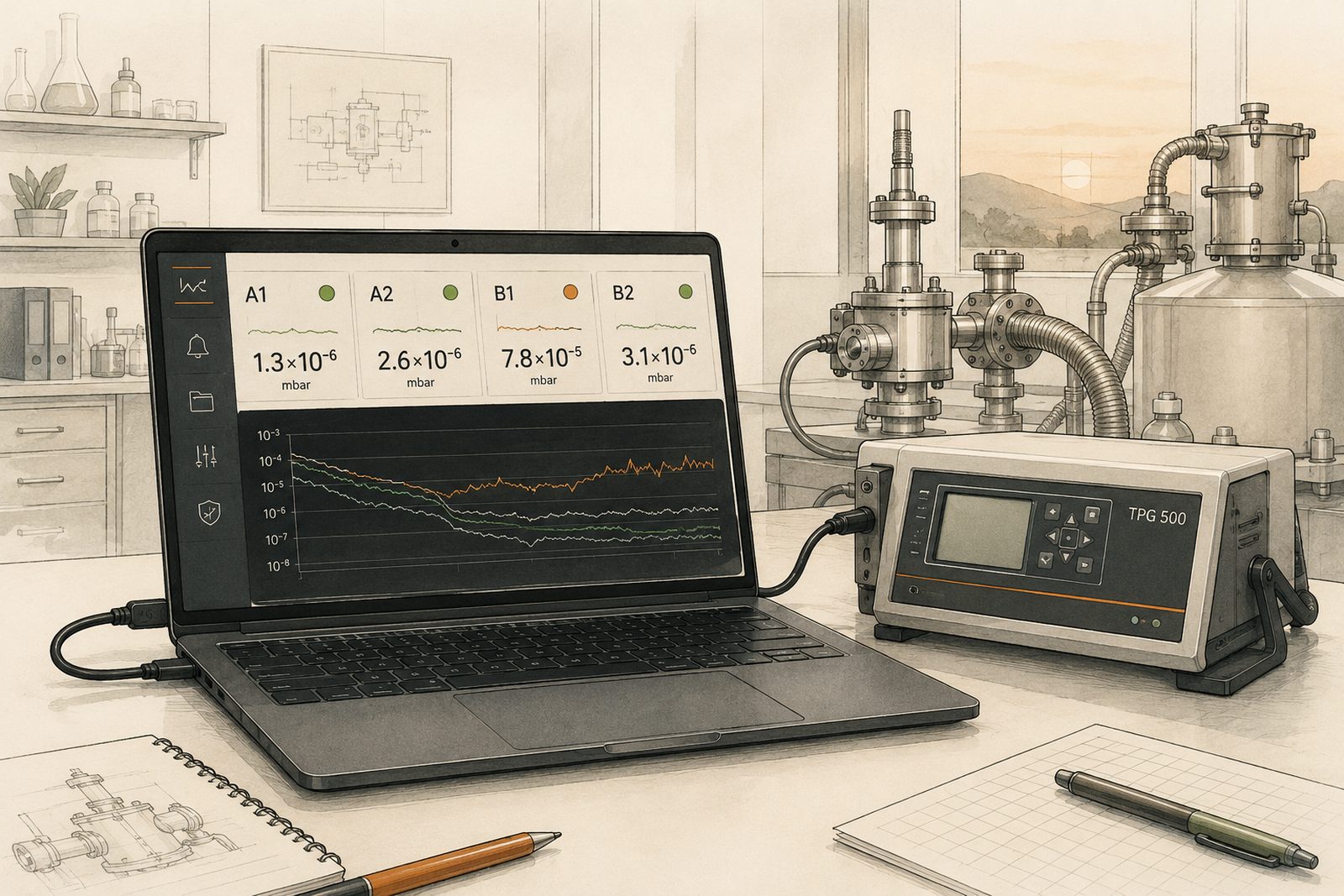
In any process under vacuum —from an evaporation coating to an analysis chamber— total pressure is not just another data point: it is the variable that decides whether the process is valid or must be aborted. Pfeiffer Vacuum's TPG 500 vacuum monitor does its measuring job well, but the engineering question starts afterwards: how do we turn that reading into a reliable history, an alarm that arrives in time and a record fit to audit the process? That is what a well-designed data-acquisition system solves.
01 What the Pfeiffer TPG 500 vacuum monitor is
The TPG 500 is a total-pressure measurement and control unit with a modular architecture. According to its documentation, it covers from atmospheric pressure down to the 10⁻¹¹ hPa range depending on the configuration, spanning practically the whole useful range of high and ultra-high vacuum. That coverage is achieved by combining interchangeable measurement cards (CP 300 series) in its connection slots, which support Pirani sensors for the coarse range and Penning (cold-cathode) sensors for the fine range, within the ModulLine family. At the instrument level, besides displaying pressure, it offers relay switching functions and an internal logging mode (data logger). That range and reliability make it the kind of instrument found in high-vacuum control systems: deposition chambers, electron microscopy, spectrometry and large scientific infrastructures such as the particle accelerators at CERN and the plants of major particle-acceleration companies, where the beam only holds if pressure stays at extremely low, stable values, and a vacuum failure can ruin hours of operation.
02 Interfaces and communication protocol
The key to extracting data lies in its interfaces. The TPG 500 exposes RS-485, USB (type A and B) and Ethernet (LAN), with Profibus and Profinet fieldbus options. Communication runs along two paths: the mnemonic protocol, based on three-character ASCII commands, and the Pfeiffer Vacuum binary protocol. The exchange is bidirectional —you read data and send commands— and there is a specific mnemonic, COM, for the continuous output of measured values. For an acquisition system, this is gold: instead of polling the instrument over and over, you can let the data flow and focus the effort on processing it. Over Ethernet, the configuration (DHCP, IP, mask, gateway) is stored in the device itself and access is handled through virtual COM ports.
03 The data-acquisition system, piece by piece
The system we have developed sits on top of that communication layer and adds what the instrument does not do by itself. A single tool covers the data's whole journey: it extracts it from the device, shares it with whoever or whatever needs it —live panels, other systems, records— and lets you control the process from it. In essence, it opens the connection with the TPG 500, interprets the measurement frames —parsing the ASCII strings of the mnemonic protocol— and normalises each reading into a time series with a timestamp and source channel. From there, the data stops being a fleeting number on a screen and becomes usable information: live charts, a queryable history and a basis for decisions. The trick is to do it robustly, accounting for automatic reconnection, frame validation and tolerance to network failures, because a measurement system that goes down without warning is worse than having no system at all.
04 Threshold alarms and change tracking
The TPG 500 already includes switching functions that trigger relay contacts when a pressure threshold is crossed, with configurable hysteresis to avoid chattering around the trip point. Our system adds the layer of intelligence above it: it detects every value change and every state change, records when and why it happened, and fires alarms to channels useful for the operator. The goal is not to duplicate what the hardware does, but to give it memory and context: it is not enough for a relay to switch, you need to know at what time, on which channel, with what value and for how long the condition held. That tracking is what turns an alarm into traceability.
05 Logging and data export
The last piece is persistence. The system performs a structured data export of everything captured —measurements, events and alarms— so it can be exported and analysed offline. This covers two distinct needs: the operational one, to review what happened during a shift or a specific process, and the documentary one, to leave auditable evidence of the vacuum conditions. Compared with the instrument's internal data logger, an external export has no device memory limit, integrates with other data sources and adapts to the format each workflow needs.
Why the software layer changes the value of the instrument
A good vacuum monitor solves the measurement; the differential value is in what you build on top. Turning the TPG 500 into a live data source —with alarms that arrive in time, tracking of every change and a history you can audit— is the difference between watching a process on a screen and understanding it with data. And it is, on top of that, a reusable foundation: the same acquisition, alarms and export architecture works for other instruments with serial or Ethernet interfaces, not just for vacuum.
And we have decided to open it up: this tool can be downloaded and we are publishing it as a public repository, so anyone can use, audit and improve it. It is the same kind of vacuum-control software that underpins flagship facilities, from the particle accelerators at CERN to the plants of major particle-acceleration companies. If you work with vacuum instrumentation, want the code or have any question about adapting it to your system, write to us through the contact form: we turn that kind of problem into executable solutions.
Back to publications