
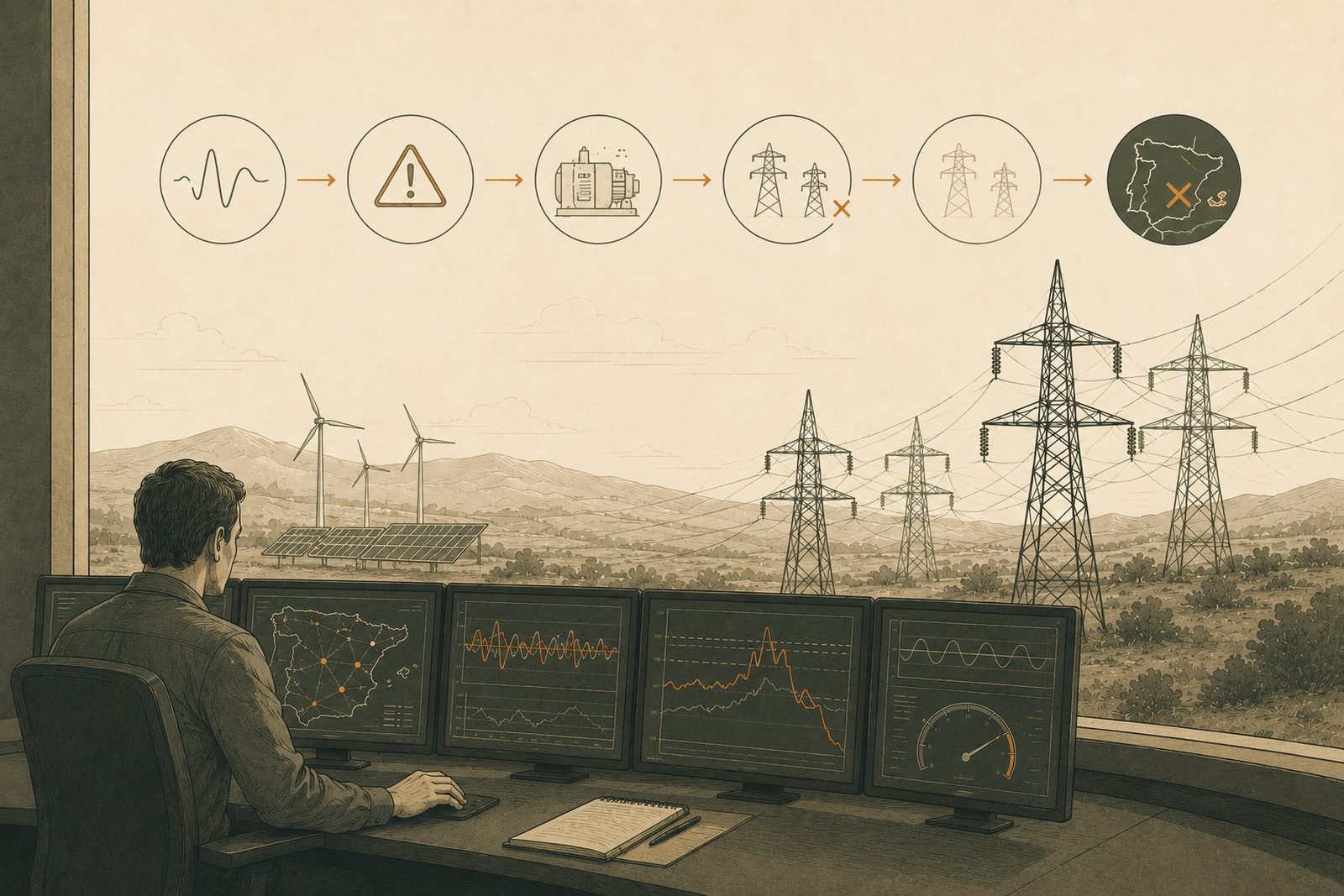
For months, the Iberian blackout was told as a fable about renewable energy: too much sun, too much wind, too little spinning machinery. It was a convenient story because it fit a pre-existing bias. The trouble is that it does not survive technical scrutiny. The final report of ENTSO-E's expert panel, published on 20 March 2026, closes the investigation with a conclusion worth reading carefully: the collapse was an overvoltage cascade, and neither inertia nor the generation mix was its root cause.
It is worth understanding properly, because the real failure lies not in a technology but in how we operate, regulate and protect a grid increasingly dominated by power electronics. That lesson applies to the whole of Europe.
01 Five seconds, fifteen gigawatts
At 12:33 CEST on 28 April 2025, the Iberian power system lost roughly 15 GW in five seconds: close to 60% of the generation online at that moment. Mainland Spain and Portugal went dark for about ten hours across most of the territory. Restoration was slow and uneven: 62% of substations were re-energised after 9.5 hours, and the Spanish system was not fully restored until around 15.5 hours later. Morocco supplied up to 900 MW through the Strait of Gibraltar link and France up to 2 GW to support the restart. This was not a flicker: it was the total collapse of a continental synchronous system.
02 The oscillations and a remedy that raised the voltage
The preceding half hour was anything but quiet. ENTSO-E identifies two episodes of power oscillations: a local one between 12:03 and 12:07, mainly affecting Spain and Portugal, and an inter-area one between 12:16 and 12:22. To damp them, operators took reasonable measures: they reduced exports towards France, coupled internal lines in southern Spain and changed the operating mode of the France-Spain link. It worked for the oscillations. But it had a decisive side effect: the voltage of the Iberian system began to climb. Here is the first engineering lesson, uncomfortable and unglamorous: stabilising one variable can destabilise another if you are not watching the whole.
03 The cascade: when voltage feeds on itself
Around 12:33, the voltage in southern Spain rose sharply and dragged Portugal up with it. From there, the system entered a positive feedback loop —the mechanism that defines an overvoltage blackout. An abnormally high voltage trips generators' protection relays, which disconnect; as generation that had been absorbing reactive power drops out, the voltage rises even further; that rise trips more protections, and so on. A transformer in Granada tripped at 12:32:57 to protect itself from the overvoltage, taking photovoltaic, concentrated-solar and wind generation down with it. The chain reaction of disconnections finally caused the frequency drop and the loss of synchronism across the entire Peninsula.
04 The reactive power that was available and never switched in
This is where the report's most revealing finding sits. Transmission-level voltage control is largely a matter of managing reactive power: injecting it to raise voltage, absorbing it to lower it. ENTSO-E found recurrent mismatches between the reactive power expected from some system users and what they actually delivered in real time, which blunted voltage control precisely when a fast response was needed. And one damning detail: a substantial shunt-reactor capacity —the classic resource for absorbing reactive power and pulling voltage down— was available and was not activated during the rise that preceded the blackout. This was not a shortage of physical resources, but a failure of visibility, coordination and timely activation.
05 Mis-set protections: the premature trip
If one word captures the avoidable side of this blackout, it is setting. ENTSO-E's analysis and Red Eléctrica's agree that many generators disconnected before reaching the voltage thresholds set out in operating procedure P.O.1.1 and in Order TED/749/2020. The cause: overly sensitive local protection settings —overvoltage measured away from the connection point, or instantaneous trips with no time delay— that needlessly disconnect generation when voltage oscillates or rises transiently. Each of those premature trips fed the cascade. A protection exists to save the equipment; poorly calibrated, it can end up bringing down the very system it is meant to protect.
06 Why inertia was not the answer
The most repeated argument was that with more synchronous generation —more heavy turbines spinning, more inertia— the blackout would not have happened. The report dismisses this without ambiguity: even with significantly higher inertia values, the loss of synchronism would not have been avoided given the specific sequence of events. Inertia damps changes in frequency, but this was, in the first instance, a voltage problem. Conflating the two has derailed much of the public debate. The statement from the chair of ENTSO-E's board is hard to misread: the problem is not renewable energy, it is voltage control, regardless of the type of generation.
The real debate: system design, not technology
Reducing this episode to a clash between renewables and nuclear is to miss the lesson. The Iberian grid reached 28 April in a fragile state: voltage instability in the preceding days, thin security margins against overvoltage and a stressed transmission topology. In that context, what failed was the voltage-control system as a whole —poorly visible and poorly coordinated reactive-power resources, miscalibrated protections, inconsistent regulation practices between actors— not the presence of panels and turbines.
The design implication is clear and forward-looking. First, reactive power has to be visible, sufficient and switchable in real time, with market incentives that reflect its value as a grid service. Second, generation protection settings must be reviewed to avoid premature trips on transients. And third, the resource that can deliver voltage control fastest —the power electronics of renewables and, above all, batteries operating as a grid asset— must move from being a passive participant to one that actively holds the voltage up. The paradox is elegant: the very technology blamed for the collapse is, when properly governed, one of the finest tools for preventing the next one. Europe does not need less power electronics on its grid; it needs to require it to regulate.
Back to publications